It started with 140 essays and a red pen.
Pastproof is a small company in Bordeaux, France, run by a former AP US History teacher who got tired of watching good students lose points they never knew existed.
The question that started it.
In the spring of 2022, a junior Nora tutored online got her third DBQ back with a 2. She had read every document. She had written four pages. She sent one line: “What does a 7 actually look like?”
Nora had taught the course for eleven years at a public high school outside Chicago and had spent six summers scoring essays at the AP Reading. She knew the answer, but no textbook showed it. So she wrote a 7 herself, then a 5 and a 3 on the same prompt, and marked every sentence in red: where the thesis point was won, where contextualization turned into a list of facts, the exact line where sourcing became analysis.
The student's next essay came back a 5. The PDF went round her class, then two other schools. By September it had a name, a cover and a price: The Seven-Point DBQ.
“Show the move, then name it.” That's still the rule on every page.
Sixteen years, one margin at a time.
From a first class of 31 juniors to ten ebooks used by students and teachers across the United States.
- 2010
First APUSH class
Nora starts teaching AP US History at a public high school outside Chicago. 31 juniors, one overhead projector.
- 2015
First summer at the AP Reading
She scores DBQs for a week in June and comes home with one lesson: readers reward moves, not length.
- 2021
A move to Bordeaux
Her partner takes a job in France. Nora keeps tutoring American students online, evenings Paris time.
- 2022
The Seven-Point DBQ
The first ebook goes on sale in September: seven DBQs, 21 essays, every point marked in red.
- 2023
The rubric changes
The College Board revises the DBQ and LEQ rubrics. Every essay is rescored over the summer and customers get the new files free.
- 2025
The exam goes digital
Students now type their essays. The timing plans are rebuilt around typing speed.
- 2026
Ten titles, all nine periods
Redlines covers 1491 to the present, and teachers use the Classroom Edition for weekly blind scoring.
How an essay earns its red ink.
We start from the sources. Every prompt is built from real primary documents, the kind the exam uses: speeches, letters, court rulings, cartoons, census tables.
We write at three levels. For each prompt we write the essay that scores 3, the one that scores 5 and the one that scores 7, so you can see what changes from one to the next.
We score blind, twice. Two former readers score each essay without seeing the other's marks. When they disagree, the essay is rewritten until the point is clear-cut.
We update when the rubric does. The 2023 revision meant rescoring everything. Buyers got the new files at no cost, and always will.
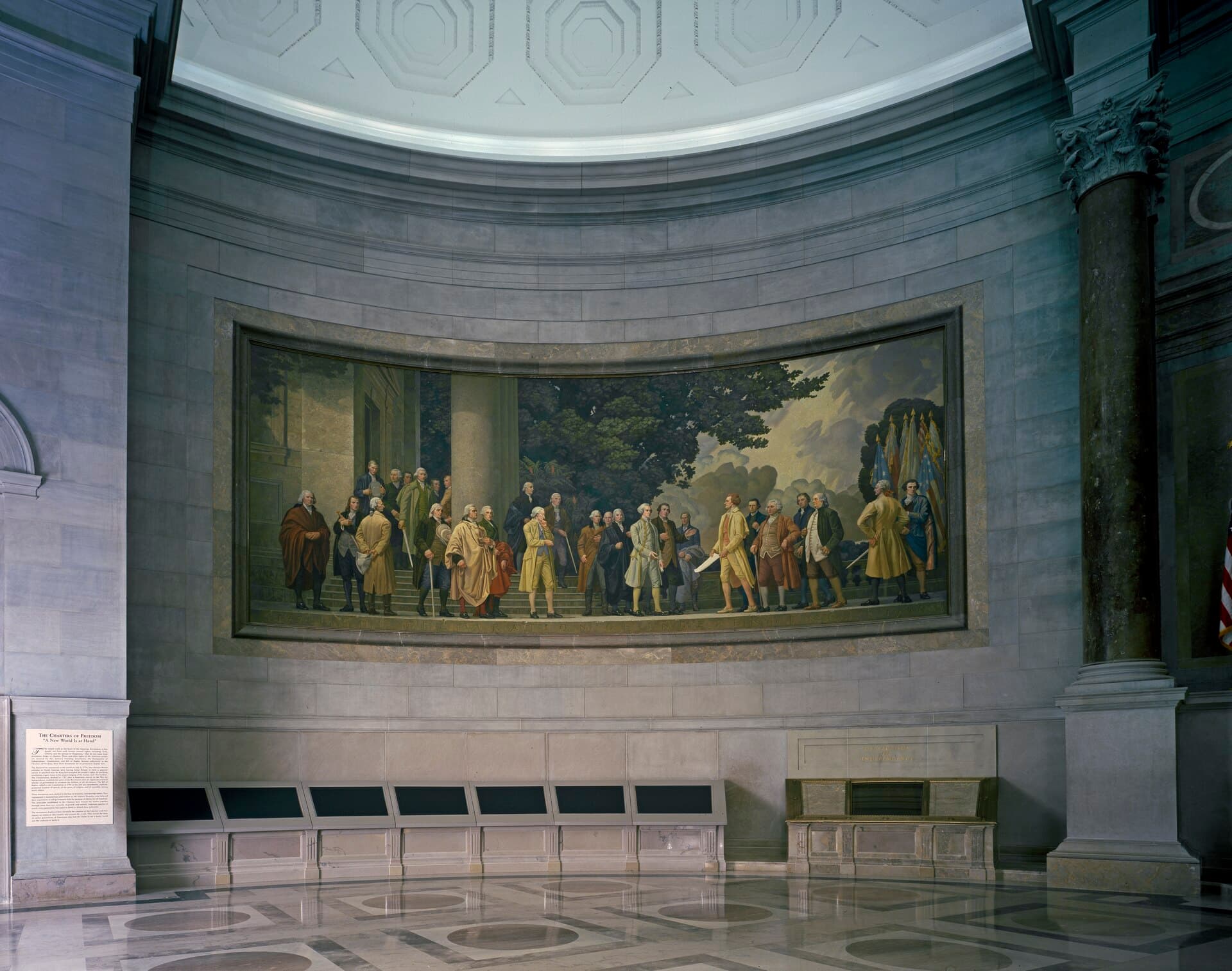
National Archives Rotunda, photographed by Carol M. Highsmith.